Protein targeting
Cellular mechanism directing proteins to correct destinations.

Ramelot, T.A., Yang, Y., Janjua, H., Kohan, E., Wang, H., Xiao, R., Acton, T.B., · CC0
Protein targeting, also known as protein sorting, is the biological mechanism by which proteins are transported to their appropriate destinations within or outside the cell. Information contained in the protein itself directs this delivery process. Correct sorting is crucial for the cell; errors or dysfunction in sorting have been linked to multiple diseases.
- field
- Cell biology, molecular biology
- known_for
- Discovery of signal peptides that direct protein targeting
- key_discovery
- Signal peptides (short amino acid sequences) act as postal codes for protein destinations
Lore & Background
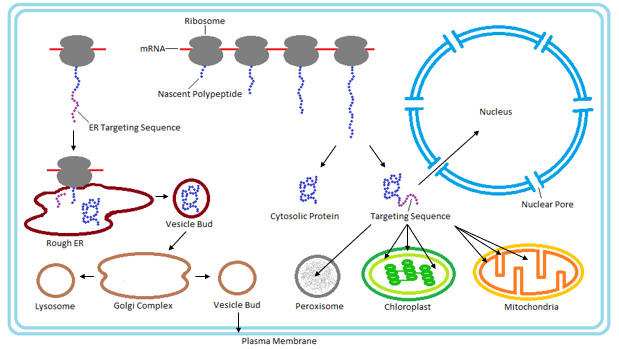
Blobel, then an assistant professor at Rockefeller University, built upon the work of his colleague George Palade. Palade had previously demonstrated that non-secreted proteins were translated by free ribosomes in the cytosol, while secreted proteins (and target proteins, in general) were translated by ribosomes bound to the endoplasmic reticulum (ER). Candidate explanations at the time postulated a processing difference between free and ER-bound ribosomes, but Blobel hypothesized that protein targeting relied on characteristics inherent to the proteins, rather than a difference in ribosomes. Supporting his hypothesis, Blobel discovered that many proteins have a short amino acid sequence at one end that functions like a postal code specifying an intracellular or extracellular destination. Signal peptides serve as targeting signals, enabling cellular transport machinery to direct proteins to specific intracellular or extracellular locations. While no consensus sequence has been identified for signal peptides, many nonetheless possess a characteristic tripartite structure: a positively charged, hydrophilic region near the N-terminal; a span of 10 to 15 hydrophobic amino acids near the middle; and a slightly polar region near the C-terminal. After a protein has reached its destination, the signal peptide is generally cleaved by a signal peptidase. Most mature proteins do not contain signal peptides. While most signal peptides are found at the N-terminal, in peroxisomes the targeting sequence is located on the C-terminal extension. Unlike signal peptides, signal patches are composed of amino acid residues that are discontinuous in the primary sequence but become functional when folding brings them together on the protein surface. Signal patches are not cleaved after sorting is complete.
Reader's Guide
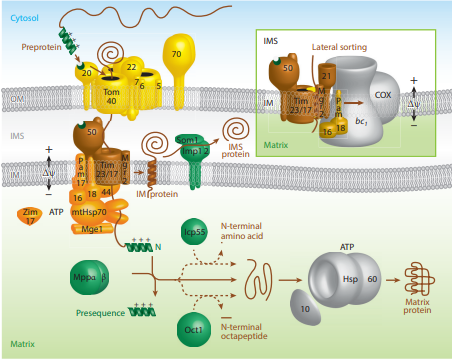
Protein targeting is a fundamental cellular process that ensures proteins reach their correct locations, whether inside organelles, on membranes, or outside the cell. The discovery of signal peptides by Günter Blobel revolutionized understanding of how cells organize their internal traffic. This mechanism is essential for proper cell function, and errors in sorting have been linked to multiple diseases. The process involves both co-translational translocation, where proteins are directed to the ER during synthesis via the signal recognition particle (SRP) and translocon complexes, and post-translational translocation for proteins destined for mitochondria, chloroplasts, peroxisomes, or the nucleus. Signal sequences vary in structure and location, with some being cleaved after delivery and others remaining as permanent anchors. The tripartite structure of many signal peptides—with a positively charged N-terminal region, a hydrophobic core, and a polar C-terminal region—is characteristic but not universal. Understanding protein targeting has implications for treating diseases caused by mislocalized proteins and for biotechnology applications such as recombinant protein production.
Did You Know?
- Signal peptides are generally 13 to 36 amino acids long and function like postal codes for protein destinations.
- Most signal peptides are cleaved by signal peptidase after the protein reaches its destination, so mature proteins usually lack them.
- In peroxisomes, the targeting sequence is located on the C-terminal extension, unlike most signal peptides which are N-terminal.
- Signal patches are composed of amino acid residues that are discontinuous in the primary sequence but become functional when folding brings them together.
Architecture and Chemical Identity
Proteins are macromolecules assembled from one or more long chains of amino acid residues, each chain termed a polypeptide. The linear order of these residues is dictated by the nucleotide sequence of a gene, read through the genetic code, which typically specifies twenty standard amino acids. In certain organisms the code extends to include selenocysteine, and in some archaea, pyrrolysine as well. Chains shorter than roughly twenty to thirty residues are generally classified as peptides rather than true proteins. Residues are joined by peptide bonds, and shortly after—or even during—synthesis they may undergo post-translational modification, a chemical reshaping that alters the molecule's physical and chemical properties, its folding, stability, and ultimately its biological activity. Some proteins additionally depend on a non-protein cofactor or ion to become functional. Rather than acting in isolation, proteins frequently associate into stable complexes to accomplish a shared task, underscoring that the three-dimensional structure each chain adopts is what governs its specific activity.
Biological Roles Across the Cell
Proteins participate in virtually every process within living cells. Many serve as enzymes that catalyse biochemical reactions and are indispensable to metabolism. Others fulfil structural or mechanical duties: actin and myosin power muscle contraction, while cytoskeletal scaffolding proteins maintain cell shape. Additional proteins drive cell signaling, mount immune responses, mediate cell adhesion, and regulate the cell cycle. Beyond the cellular level, animals depend on dietary protein to supply essential amino acids they cannot synthesize on their own. Once ingested, dietary proteins are digested into free amino acids that replenish the body's amino acid pool. This pool is used primarily to build new body proteins but is also critical for energy production and for generating other nitrogen-containing molecules vital to physiology. In this way, proteins bridge the gap between molecular chemistry and organism-level function, appearing in nearly every process within living cells.
Lifespan, Turnover, and Quality Control
Once a protein is formed, it does not persist indefinitely. Every protein carries a finite lifespan, measured as a half-life, that can span from mere minutes to several years, with mammalian cells averaging roughly one to two days. At the end of this window, the cell's machinery degrades and recycles the molecule through a process called protein turnover. Misfolded or abnormal proteins are eliminated more rapidly, often by the proteasome—a large protein assembly in its own right. Degradation can be triggered either because the protein is inherently unstable or damaged, or because it has been specifically targeted: ubiquitin ligases can tag a protein for destruction. This quality-control system ensures that only properly folded, functional molecules remain active in the cell, while defective ones are swiftly removed and their constituent amino acids returned to the pool for reuse. The interplay between synthesis, modification, and controlled degradation thus keeps the proteome in a dynamic, regulated state.
From Albuminous Materials to a Named Molecule
The recognition of proteins as a distinct class of biomolecules stretches back to the 1700s, when Antoine Fourcroy and others grouped them under the umbrella term albumins or albuminous materials. Gluten was first isolated from wheat in published research around 1747, and Fourcroy later distinguished three animal protein varieties: albumin, fibrin, and gelatin. The definitive naming arrived in 1838, when Dutch chemist Gerardus Johannes Mulder performed elemental analyses showing that common proteins shared a strikingly similar empirical formula. His associate, Swedish chemist Jöns Jacob Berzelius, proposed the name protein, derived from the Greek proteios, meaning primary or standing in front. Mulder also identified degradation products such as the amino acid leucine. Early nutritionists like Carl von Voit regarded protein as the paramount nutrient for bodily structure. Later, Osborne and Mendel identified essential amino acids through rat-feeding experiments, and William Cumming Rose discovered the final one, threonine. The difficulty of purifying individual proteins persisted until the 1950s, when the Armour Hot Dog Company made a kilogram of bovine pancreatic ribonuclease A freely available, transforming it into a major biochemical research target.
Gallery
Frequently Asked Questions
Who is Protein targeting?
Protein targeting, also called protein sorting, is the cellular mechanism responsible for delivering newly synthesized proteins to their correct destinations, whether inside the cell or outside of it. It operates based on information encoded within the protein itself.
What are Protein targeting's powers or role?
Its core function is to read the built-in address information on a protein and route it to the right compartment or extracellular location. Without this sorting process, proteins would accumulate in the wrong place and fail to perform their jobs.
How does Protein targeting work?
The system relies on short amino acid sequences called signal peptides, which act like postal codes embedded in the protein. These sequences are recognized by cellular machinery that then directs the protein along the appropriate transport pathway.
Why is Protein targeting important?
Correct sorting is essential for normal cell function, and when the process breaks down, the resulting mislocalization of proteins has been linked to a range of diseases. In essence, it keeps cellular logistics running so each protein can carry out its specific job.
What is Protein targeting's key discovery?
The landmark finding in this area was the identification of signal peptides—brief stretches of amino acids that serve as destination tags for proteins. This discovery revealed that the protein itself carries the instructions for where it needs to go.
More in Cellular And Molecular Biology 25-36
Elsewhere in the Cellular And Molecular Biology universe
Spotted an error? Know more?
This is a living reference — every entry is fact-audited, and reader corrections feed straight into our audit queue. Suggest an edit · See this site's audit record